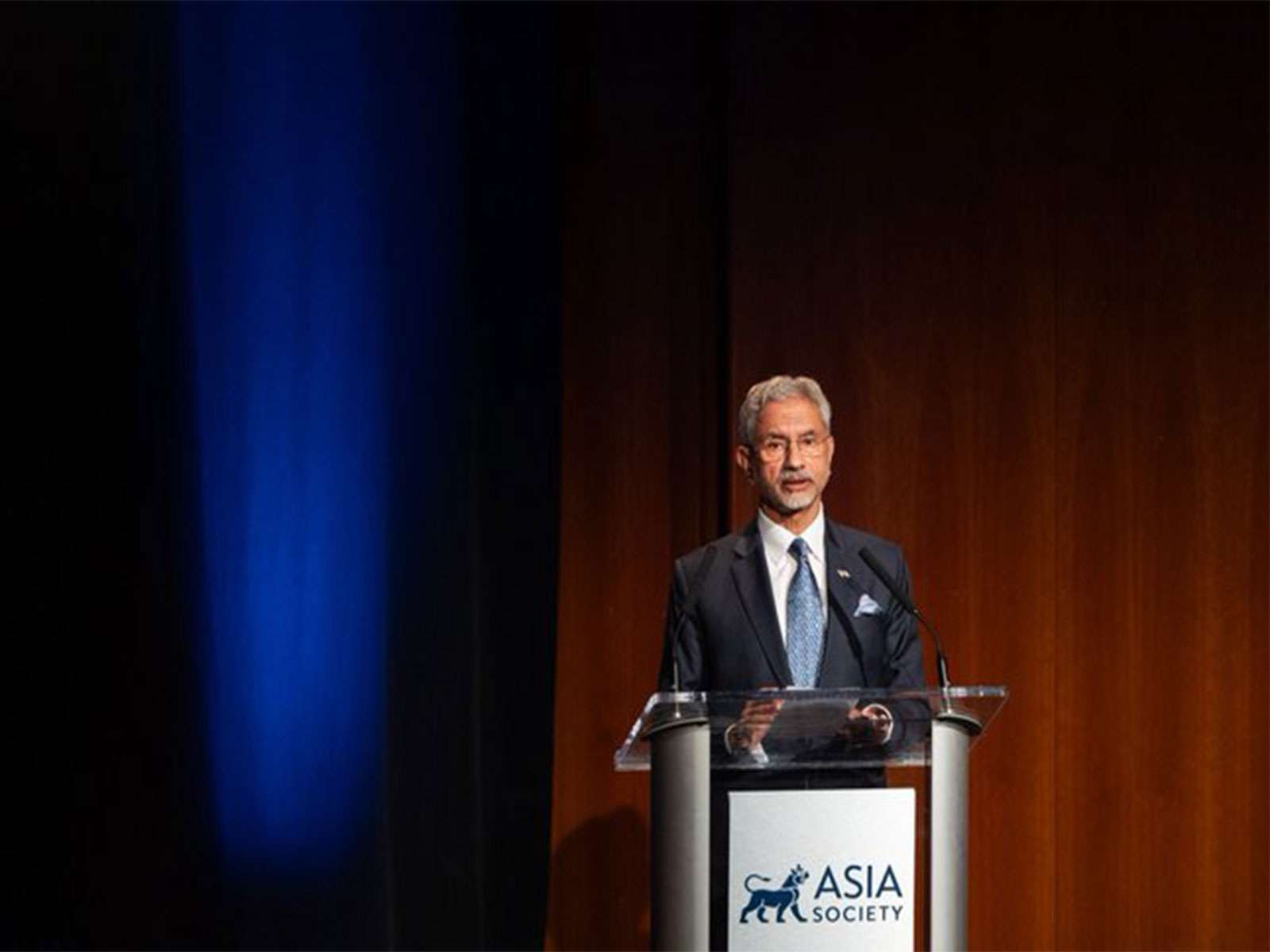
New York [US], September 29 (ANI): External Affairs Minister S Jaishankar has observed that the geopolitical landscape is deeply rattled by active warfare, fiscal pressures, and the rising weaponisation of trade links, cautioning that contemporary statecraft entails extraordinary risks as nations vie for leverage.
Speaking at an event organised by the Asia Society in New York, EAM Jaishankar drew attention to two major ongoing conflicts, widespread instability across West Asia, armed fighting in parts of Africa, and increasing systemic strain bearing down on the developing world. He noted that global supply chains face growing fragility while essential resources including food, fuel, fertilisers, and financial mechanisms remain heavily pressured.
Describing the friction between economic integration and state rivalry as a defining dilemma, he stated that “the paradox of our times” involves countries remaining deeply connected yet increasingly inclined to use those connections as sources of leverage.
“The interdependence is the reality, the competition is the sentiment,” EAM Jaishankar said, adding that policy formulation continually reflects the intense challenge of balancing these opposing realities.
He explained that when one country depended on another for a critical need, intense competition created an incentive to turn that dependence into a tool of pressure, resulting in a more hazardous environment for governments trying to protect their interests while keeping relationships intact.
“Diplomacy has become an extreme sport,” EAM Jaishankar said, explaining that diplomats had to respond to high-risk decisions and their consequences, while retaining the patience needed to work through longer disputes.
He highlighted several strategic chokepoints, identifying critical geographic shipping routes, economic sanctions, travel restrictions, and market access points. States possessing direct influence over any of these gateways showed an increased readiness to deploy them against strategic rivals.
Stating that energy markets and technological advancements had further altered calculations, EAM Jaishankar explained that disruption in a major energy-producing region had raised prices and forced countries to adjust, while advances in military technology could also give governments greater confidence in taking risks.
Arguing that the world had become more impatient, he noted that where deterrence had once been a common approach, countries with new capabilities could feel a temptation to use them, describing it as a “use it or lose it” mindset.
Furthermore, EAM Jaishankar pointed to a broader rebalancing of global economic and political power. Rising economies and established nations experiencing relative declines were both actively adjusting to these shifts, generating uncertainty that reverberated through domestic politics and international relations alike.
Questioning whether multilateral architectures founded under outdated power hierarchies can effectively adapt, he observed that the UN began with 51 members in a vastly different world, and its future relevance depended in part on how it responded to present-day realities.
EAM Jaishankar mentioned that countries were seeking new partners, diversifying their relationships and looking for ways to reduce risk, adding that new understandings could emerge, though he expected negotiations to be difficult.
Offering a pragmatic outlook during a subsequent discussion, EAM Jaishankar stated, “I’m not pessimistic about the world,” noting that countries had an interest in finding stable and reliable arrangements even as competition intensified.
The United Nations was established in 1945, after the Second World War, and while its membership and work have expanded substantially since then, debate has continued over whether its decision-making structures adequately reflect today’s world.
India has called for reform of international institutions and a greater voice for developing countries, also working through forums with different memberships, including the G20, BRICS and the Quad. (ANI)
EAM Jaishankar warns of more uncertain global order